

Cleaner heads. Stronger throw. Less scale.
The Magnation Hydrodynamic Process for golf course irrigation. Installed at your pump station, it conditions the water before it reaches every head on the course.
What Superintendents Fight Every Season
-
Scale on heads and nozzles
Calcite scale builds up in heads, nozzles and screens. The opening narrows and the spray pattern breaks up.
-
Iron staining
Iron in irrigation water oxidizes and leaves orange stains on cart paths, walls, rocks and clubhouse surfaces.
-
Pump energy and friction loss
Scale and friction in the pipe make pumps work harder to deliver the same flow and pressure.
-
Uneven coverage
Clogged nozzles and lost pressure leave dry spots and wet spots, which means more hand watering.
The Science Behind the Process
What 18 years of Magnation installations in the field have shown.
-
Calcite to Aragonite
Calcium carbonate can form hard, sticky calcite scale or fine aragonite crystals that stay suspended and flush through. The Magnation Hydrodynamic Process is designed to favor aragonite, so less scale builds up in heads, nozzles and pipe.
-
Iron Stays Ferrous
Dissolved ferrous iron oxidizes to ferric iron, the rust-colored form that stains. In the field, Magnation-treated water has shown less iron staining by helping keep iron in its dissolved ferrous form.
-
Lower Friction Loss
Pipe friction loss drives pumping energy. Controlled turbulence is engineered to reduce friction loss, so pumps can move more water for the same effort.
Proven on Golf Courses
-
80+ units in Colorado
Including City of Aurora golf courses, with Magnation on Arms pumps and Watertronics pump stations at Colorado golf courses.
-
450 to 510 gpm
A Marin city flow test on a 2-inch hose at 80 psi went from 450 gpm to 510 gpm with Magnation.
-
3-inch Rainbolt on 206 heads
A 3-inch Magnation Rainbolt feeding 206 sprinkler heads delivered uniform throw across the system. Video coming soon.
-
Blackhawk Country Club
Read the case studyA seven-month trial on Fairway 3 used 10% less water on the treated side, with 25% lower surface salt readings.
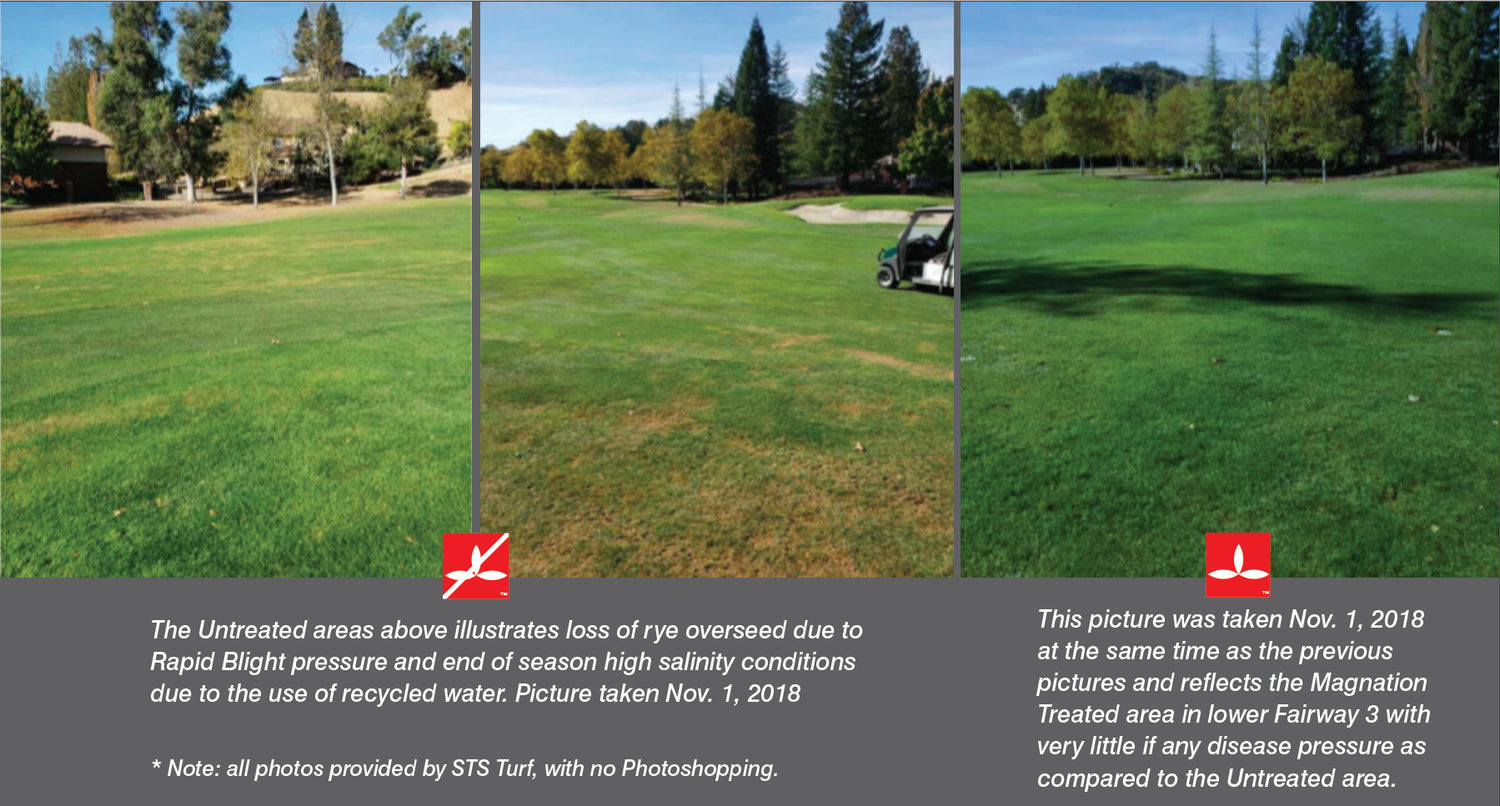
Blackhawk Country Club
Side-by-side photos of an untreated area and a Magnation-treated area at Blackhawk Country Club, taken on the same day. Photos provided by STS Turf.
A seven-month trial on Fairway 3 used 10% less water on the treated side, with 25% lower surface salt readings.

Where It Goes in Your Pump Station
- Installs on the discharge header of the pump station, so every zone downstream gets treated water
- Standard flanged spool piece, sized to line size, in 316 stainless steel. Bolts in flange to flange.
- Specify it in a new station or add it as a retrofit
No moving parts. No power.
Pump station design with a 20-inch spool piece for the Magnation unit, drawn by Watertronics.
See the TurbulatorMore Golf Case Studies
-
Orinda Country Club
Read the case studyDry, compacted fairways turned into healthier turf while using water more efficiently.
-
Cordova Bay Golf Course
Read the case study -
Brook Lea Country Club
Read the case study
FAQ
Superintendent Questions
Our water is hard. What is it doing to the irrigation system?
Hard water carries calcium carbonate that drops out as calcite scale in pipes, heads, nozzles and screens. Over time that narrows openings, breaks up spray patterns and adds friction in the lines. The Magnation Hydrodynamic Process is designed to favor aragonite, a form that stays suspended and flushes through instead of sticking.
How does the Magnation Hydrodynamic Process actually work?
Water flows through a 316 stainless steel unit with no moving parts and no power. Across 18 years of field installations, three effects show up: calcium carbonate forms aragonite instead of sticky calcite, so less scale builds up; iron stays in its dissolved ferrous form instead of oxidizing to the ferric form that stains; and friction loss in the lines drops. Results vary by water source, soil and site.
Will it help with mineral scale in my lines, sprinkler heads and nozzles?
That is the most common reason superintendents install it. With less calcite sticking to surfaces, heads and nozzles stay cleaner and throw patterns hold up. A 3-inch Magnation Rainbolt feeding 206 sprinkler heads showed uniform throw across the system.
Can it even out my wet areas and dry areas?
Wet and dry areas often come from clogged nozzles and lost pressure. Keeping heads cleaner and cutting friction loss helps the system deliver a more even throw, as the 206-head Rainbolt test showed. Every course is different, so we look at your water and layout before recommending a unit.
What about hydrophobic soils and localized dry spots?
Superintendents use Magnation to help water soak in instead of beading up on hydrophobic patches. At Cordova Bay Golf Course, superintendent Dean Piller reports 25% less wetting agent and fertility. At Claremont, Josh Clevenger reports that salt is not building up.
Will it reduce runoff on slopes and tight lies?
When water soaks in more evenly, less of it runs off slopes and into drains, and you need less of it to keep turf healthy. Aaron Smith at Red Rocks reports a significant water reduction along with better roots. Results vary by soil, slope and water source.
How much water can we realistically save?
Results vary by water source, soil and site, but superintendents are seeing real numbers. Walking Stick Golf Course in Pueblo, Colorado reports 30% savings in water and energy, and Cordova Bay reports saving about 80,000 gallons a night and buying 15% less water. Reunion Metropolitan District saved $60,000 a year. At Blackhawk Country Club in Danville, California, a seven-month trial on Fairway 3 used 10% less water on the treated side, with 25% lower surface salt readings.
Our pumps run hard all season. Can it cut pump energy?
Friction loss drives pumping energy, and lower friction means pumps can move the same water with less effort. Walking Stick Golf Course in Pueblo, Colorado reports 30% savings in water and energy. Ryan Davis at Hiwan Golf Club put an 8-inch stainless Magnation unit in his pump house, cut 5% off the top of the board and paid for it within a year.
Will we use less wetting agent, fertilizer and other chemicals?
Superintendents report 10 to 50% reduced inputs, depending on the site. At Cordova Bay, Dean Piller reports using 25% less wetting agent and fertility. The Blackhawk Country Club trial also reported a reduced need for wetting agents. Results vary by water source, soil and management program.
Does it improve playability?
More even moisture and stronger roots lead to more consistent surfaces. Aaron Smith at Red Rocks reports better roots and no tearing during aerification. Fewer wet spots and dry spots also mean fewer areas that play differently from the rest of the course.
Will it reduce maintenance and hand watering?
Less scale in heads and nozzles means less time cleaning and adjusting them, and the unit itself has no moving parts, no power and nothing to refill. Dean Piller at Cordova Bay reports reduced hand watering after installing Magnation.
Where does it go, and is it proven on courses like mine?
It installs on the discharge header of your pump station as a flanged spool piece, sized to line size and bolted in flange to flange, in a new station or as a retrofit. There are 80+ Magnation units in Colorado, including on Arms pumps and Watertronics pump stations at Colorado golf courses.
How do I know it will pay off for my course?
Start with our ROI Calculator using your own water and energy numbers. Ryan Davis at Hiwan Golf Club paid for his unit within a year, and results vary by site. For a consultation, call 888-820-0363 or email info@rainlikewater.com.
Talk to a Golf Rep
Call 888-820-0363 or email info@rainlikewater.com. We will help size a Turbulator for your pump station.